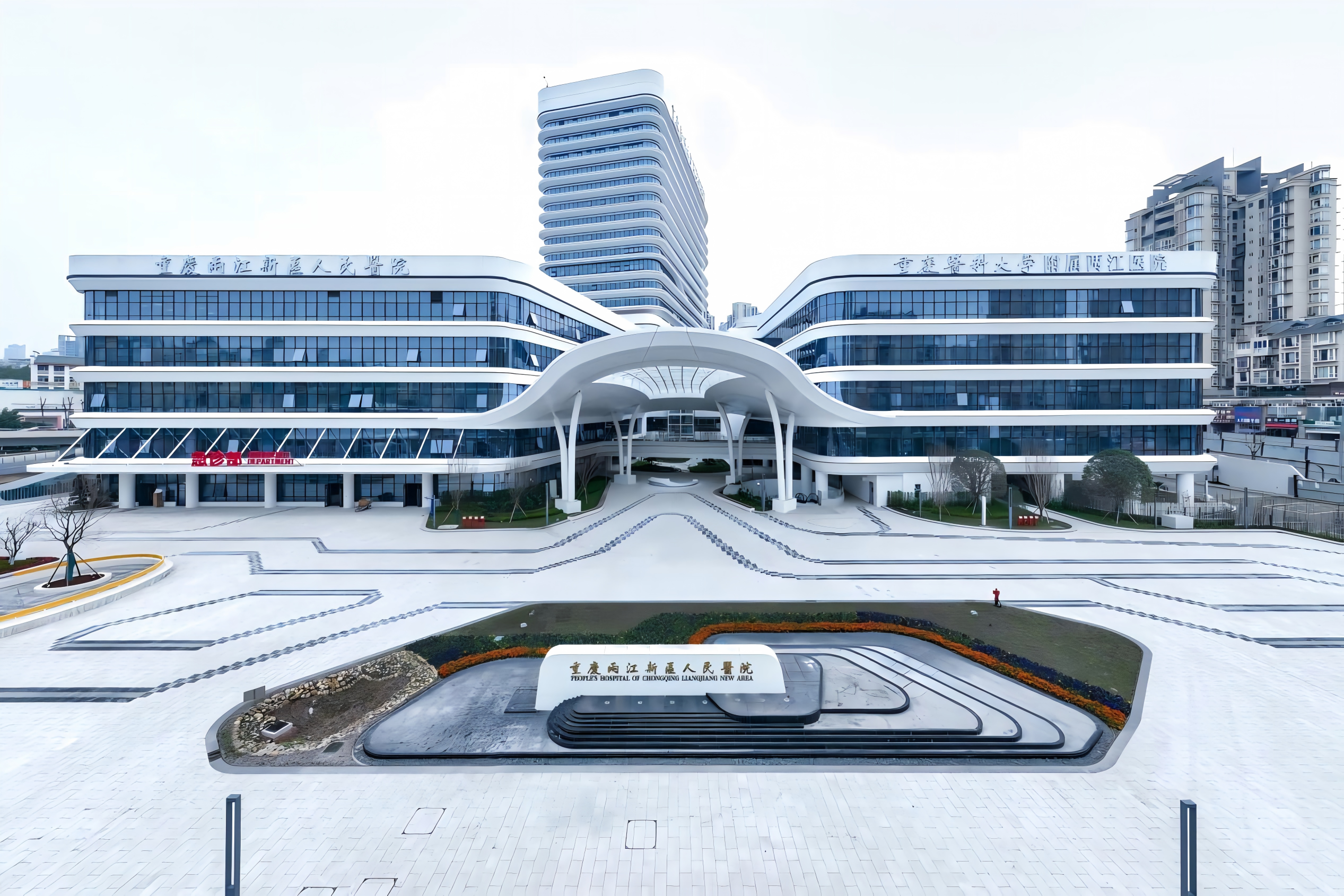
Founded in 1957, Chongqing Liangjiang New Area People’s Hospital is a non-profit public medical institution under the administration of Liangjiang New Area. It covers a service area of approximately 1,360 square kilometers and serves a population of around 3.52 million. Built as a Grade A tertiary general hospital providing full-life-cycle medical services, it integrates medical treatment, scientific research, teaching, disease prevention and healthcare, emergency rescue, childcare and elderly care. In September 2024, the Administrative Committee of Chongqing Liangjiang New Area and Chongqing Medical University jointly unveiled the plaque officially designating the hospital as Liangjiang Hospital Affiliated to Chongqing Medical University.
I. Basic Overview
(I) Hospital Scale
The hospital operates three campuses:
Campus A: Centered on clinical internal and surgical disciplines, regional first aid and critical care for severe illnesses;
Campus B: Focused on health management, geriatrics, traditional Chinese medicine rehabilitation and childcare services;
Campus C (Lijiang Medical & Senior Care Center): A model medical-elderly care complex catering to mid-to-high-end elderly care demands.
The three campuses jointly form a high-quality medical service network covering full-life-cycle health needs and radiating across western China, continuously optimizing patient experience and supporting the Healthy China Initiative.
The hospital governs 5 community health service centers (Yuanyang, Cuiyun, Renhe, Jinshan and Tiangongdian) and 8 community health service stations, serving over one million residents. It has 764 authorized hospital beds and 360 medical-elderly care beds (316 for elderly care, 44 for medical use), with 1,000 beds actually in service. The total floor area of operational premises reaches 345,500 square meters, including 265,000 sq.m. for Campus A, 62,000 sq.m. for Campus B and 18,500 sq.m. for the medical-elderly care center and other facilities.
(II) Talent Team
The hospital employs 1,810 staff members, among whom 1,521 are health professionals, accounting for 84.03% of the total workforce. There are 229 staff with associate senior professional titles or above and 771 with intermediate professional titles, plus 460 masters and doctors.
415 staff serve as committee members of municipal-level and above medical special committees, with more than 10 holding editorial board positions of statistical source journals. Disciplines including the Neurology Center, Department of Cardiovascular Medicine and Department of Thoracic Surgery rank among the top tier in the region. In recent years, the introduction of high-level medical talents has injected strong momentum into disciplinary development.
(III) Specialized Discipline Development
The hospital comprises 22 functional departments, 41 clinical departments and 8 medical technology & pharmacy departments. Its key featured disciplines are as follows:
1 featured specialty recognized by the National Administration of Traditional Chinese Medicine and flagship integrated Chinese-Western medicine department of Chongqing: Department of TCM Rehabilitation;
1 county/district-level Clinical Pharmacy Center of Chongqing: Department of Pharmacy;
5 Municipal Key Clinical Specialties of Chongqing: Emergency Department, Department of Gynecology, Department of Obstetrics, Department of Endocrinology and Metabolic Diseases, Department of Respiratory and Critical Care Medicine;
1 Municipal Featured Medical Specialty of Chongqing: Department of Gastroenterology;
3 District-level Key Clinical Specialties: Department of General Surgery, Department of Endocrinology and Metabolic Diseases, Department of Gastroenterology.
As the designated regional treatment center for stroke, chest pain, trauma, high-risk maternal and critically ill newborn cases in Liangjiang New Area, the hospital takes the lead in constructing eight municipal/district medical quality control centers within the new area: Nursing Quality Control, Hospital Infection Control, Medical Laboratory Quality Control, Stomatological Medical Quality Control, Emergency Medicine Quality Control, Digestive Endoscopy Quality Control, Medical Record Management Quality Control, and Respiratory Medicine Quality Control. This creates a full-process quality control system to steadily standardize medical safety management.
(IV) Medical Technology
The hospital delivers all medical services consistent with Grade A tertiary hospital standards. It took the lead in carrying out numerous high-difficulty diagnosis and treatment procedures, including Extracorporeal Membrane Oxygenation (ECMO), radioactive seed implantation, precise catheter ablation for arrhythmia, complex coronary intervention, interventional diagnosis and treatment for neurovascular diseases, cerebrovascular interventional therapy, radical resection of various malignant tumors, and autologous stem cell transplantation.
It pioneered the one-day surgery model for hip and knee arthroplasty. Its minimally invasive surgery, endoscopy, angiography, interventional therapy and critical care technologies hold a leading position in the region.
(V) Research & Teaching Development
In recent years, the hospital has prioritized disciplinary construction and recruitment of high-level medical talents, with focused development of key specialties: Neurology Center, Cardiovascular Center, Department of Thoracic Surgery, Department of Hepatobiliary and Pancreatic Surgery, Department of Orthopedics, Department of Oncology, Department of Gastroenterology, Department of Critical Care Medicine, Department of Endocrinology, Department of Obstetrics and Gynecology, Palliative Medicine, Clinical Laboratory and Interventional Department. Multiple technological breakthroughs have been achieved, establishing the hospital as a regional benchmark with city-wide disciplinary influence.
The hospital holds qualifications for clinical trials of pharmaceutical products and runs a dedicated Clinical Trial Office. Over the past three years, it has applied for nearly 110 vertical research projects, among which 31 provincial and ministerial-level projects were approved. More than 130 high-quality papers have been published, over 100 of which are indexed in SCI journals. A total of 136 patents have been authorized, including 4 invention patents and 132 utility model patents.
As the supporting institution for the Third Batch National Regional Medical Center (Union Hospital, Tongji Medical College, Huazhong University of Science and Technology Chongqing Branch), the hospital upgrades its capacity for regional critical and complex disease diagnosis and treatment through technology transfer and resource collaboration, enabling local residents to access premium medical care without traveling far.
Relying on the co-construction platform between Liangjiang New Area Administrative Committee and Chongqing Medical University, the hospital has built an integrated university-hospital collaborative innovation system to boost teaching development through resource integration. It regularly accepts interns from Chongqing Medical University, Chongqing College of Pharmacy and other medical colleges. Teaching infrastructure has been comprehensively upgraded, featuring an intelligent library covering over 1,600 square meters and modern student dormitories that provide superior study and accommodation conditions for trainees.
Focusing on faculty development, the hospital optimizes its teaching staff structure and routinely organizes teaching ward rounds and surgical demonstrations to improve clinical teaching competence. Up to now, 19 core medical staff have been awarded Chongqing Municipal Talent titles including the "Leading Talents" and "Young Outstanding Medical Talents", forming a sustainable training ecosystem where senior experts mentor mid-career specialists, who in turn cultivate young practitioners.
(VI) Medical Equipment
The hospital is equipped with advanced diagnostic and therapeutic devices, including MRI, ultra-high-end CT, dual-source CT, DSA, DR, Cone Beam CT (CBCT) for stomatology, flat-panel digital fluoroscopy system, 3D stereotactic system, holmium laser lithotripsy system, pulmonary function tester and 3D labor navigation system. The total value of medical equipment is projected to exceed 480 million RMB by the end of 2025. All large-scale medical equipment has obtained official configuration permits and maintains high operational efficiency, laying solid hardware support for precision medicine.
(VII) Development Plan
Guided by the goal of building a high-level international affiliated hospital of a medical university, the hospital aims to develop into a leading Grade A tertiary general hospital delivering full-life-cycle healthcare and a benchmark urban medical group in Chongqing.
Leveraging the institutional advantages of Liangjiang New Area as a national-level new district, the hospital plans to construct an international medical center, childcare center, medical-elderly care center, cell storage and therapy center, as well as a transformation platform integrating medicine, enterprises and research institutes. It will establish an open collaborative platform built on "specialty centers + technology clusters", steadily developing cutting-edge innovative medical services, high-end international medical services and high-quality consumer healthcare services, so as to lead and drive high-quality development of healthcare undertakings in Liangjiang New Area.


 Guangdong, China
 直付网络查询
 我的
我的 语言:CHINESE,ENGLISH
 一键拨打
一键拨打